Showing posts with label thinking. Show all posts

Mar 11, 2009

Spring Break Guilt

Monday I told myself that I was going to spend the day working on comps and/or grading papers. I stayed in my pjs and played on the internet. Tuesday, I told myself that I deserved a day off and I could just get started on Monday's plans and not feel guilty about it. I got a hair cut, went shopping, and played around with new blog templates. This morning I woke up and felt incredibly guilty for not having accomplished anything for school (or really anything on my To Do list*).

I know that my students are not working on projects for my classes, so I shouldn't really feel obligated to have graded all of their papers over the break.** My advisor isn't working during the break, so I shouldn't really feel obligated to finish everything for comps. All that said, I still do. I feel like I've wasted my break if my only accomplishments were uploading new blog templates, watching tv, shopping, and getting a hair cut.

I'm not sure quite when this guilt developed. I know that as an undergrad, I did not feel guilty about escaping school during breaks. Is this something I learned in grad school orientation? Can I sue for pain and suffering if I find the source of this guilt? I know that my students are not sitting at home wondering if they should be working on something for school.

So, halfway through Spring Break, I have not finished the baby's room or cleaned out the closet or written lesson plans or graded anything or worked on my sythesis statements. I feel guilty about all of these things, but not guilty enough (as of yet) to give up doing nothing. Maybe I'll start being a grad student again tomorrow, but I think I'll pretend like I'm an undergrad for one more day.

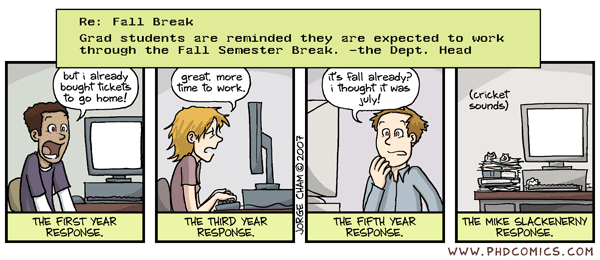
As alway, PhD Comics understand this dilema...

*Maybe I'll start feeling more successful if I include items like "play on Facebook" and "stay in pjs all day" on my lists.
**For the record, they turned them in the Friday before the break.

Jan 27, 2009

Blog Death

I feel like my blogs are dying a slow death. I'd love to say that it is because I have been too busy to blog, but in reality it's because I haven't quite figured out where the boundaries between my 3 blogs are. When I separated out my blogs, I did so because I didn't want to clutter this blog with recipes and then later with baby news.

The recipe blog sadly still gets lots of traffic despite the fact that I haven't added new recipes in months.* I have a stack of recipes sitting on my desk waiting to be added, but I never got around to taking pictures, so I haven't messed with them lately. As I started reading more recipe blogs and following recipe bloggers who discovered me, I was so overwhelmed by the fact that most of these people average 4-6 *new* recipes each week that I kinda let this one go. I don't even try one new recipe a week, except maybe in the summer time, and quite honestly I don't have the time or desire to make that kind of commitment right now.

This blog faired slightly better, but has still been slowly dying. Part of this is becuase I told myself I didn't want to put baby news here and the line between baby and non-baby is incredibly blurry for me right now. As a result of not knowing where my own boundary was, I kinda just quit posting.

The baby blog is the only blog that is getting regularly updated at least once a week at the moment. Part of me thinks that I should have combined the baby blog and this personal blog, but in all honestly I like the freedom of having this blog to write about things that aren't exactly aimed at my family. We are also using that baby blog to replace emailed pregnancy updates for family and friends scattered across the country, so I feel like it would overwhelm this blog.**

At the same time, I miss this blog. I rarely feel like I have to censor myself or my thoughts on this blog, which I can't say about the baby blog. Frequently, I find myself wanting to blog about something and then opting not too because of the potential to offend or "start something" with opinionted family members. I never have that feeling here.

So, in short, I'm going to work on trying to rediscover that balance. It may mean that you may start seeing more baby stuff here (my apologies to those who aren't interested in baby updates), but please bear with me as I try and figure out how to reorganize these three blogs into something that works for my readers but also for me as a writer. I'm not ready to kill off any of the three blogs, but I'm working on finding a division that works.


*In my weak defense, my relationship with food since I got pregnant meant that I haven't cooked as much. I will admit that neither cracked pepper Triskets nor baked potatoes contain carrots, but I feel bad about posting carrot-free weird pregnancy cravings on that blog when its primary audience is people looking for allergy-friendly recipes.
**We're also using it help smooth out issues (like using cloth diapers) that some of our family members might take issue with. Since we have wide variety of opinions and cultural perspectives in our family, it seems like I spend quite a bit of time defending decisions and trying to make sure no one is suprised and no one is offended.

Jan 20, 2009

History

I don't know that I even have words to talk about what I just watched. I've spent the morning watching the live coverage of Barack Obama's inauguration. While I will admit that the last couple of days have seemed a little excessive in terms of 24 hour news coverage, I can't believe that in a matter of minutes we went from time filling factoids (Obama hates coffee, but collect comic books, etc) to a truly monumental time in history.

It seems surreal that less than an hour ago, a man that would at one time not have been allowed to vote was just sworn in as President. This election has been momumental in many ways and it struck me today that when our baby is born in May, he/she will never have a concept of a time when the office was an office that had only been held by white men. The fact that our country embraced diversity in terms of ethnicity and gender in this election season is one of the most valuable parts of this election for me. I agree with Obama on many of his policies and visions, but I am even more proud to live in a country that fought so bitterly of policies during the primary and election, yet came together to support a historic transition.

Part of me is sad that I spent this historic moment at home alone watching what seemed like a very global moment. At the same time, even when my internet kicked me off Twitter and Facebook, I still felt an odd sense of the country standing still. Even moments before the ceremony was set to take place, I was contemplating running up to campus so I could experience this moment with other people. I was too afraid of missing it to actually go anywhere, but I was shocked at how connected I felt even alone in my living room. I hope this sense of unity is something that doesn't wane in the coming hours and days.

I know that there are still those who will fail to recognize the true value of this moment or will fault President Obama regardless of what he does, but I was moved by the humbleness and greatness of what I just watched.

Sep 13, 2008

Offensive Politics

Recently I've heard conversations about the inappropriate nature of a recent (and unapproved, I might add) slogan that says: "Jesus Christ was a community organizer and Pontius Pilate was a Governor." What I find most unnerving about the conversations labeling such a slogan as blasphemous and offensive, is that they imply that religion is off limits for humor and satire.

I find this unnerving because this afternoon I returned from lunch where we had a lovely, intelligent, and productive conversation about religion, ideology, politics, feminism, and other issues worthy of discussion to read a story about "Obama Waffles." The waffles invoke two major stereotypes: the racist imagery of Aunt Jemima combined with the head coverings worn by Muslim men.* The mixes were sold at a forum co-sponsored by American Values and Focus on the Family Action. To be fair, the forum later discontinued sales of the waffle mix (after 3 days): saying they had not realized the boxes displayed "offensive material." The creators had this to say about the problematic images:
"We had some people mention that to us, but you think of Newman's Own or Emeril's — there are tons and tons of personality-branded food products on the market. So we've taken that model and, using political satire, have highlighted his policies, his position changes.
So here's my question, are we going to label this as blamphemous or is it okay to make race and religion the subject of satires as long the religion isn't Chritianity. For all of those who cried fowl at the unauthorized Jesus Christ was a community organizer slogan, I challenge you to demand aplogies for this as well. If religion is off limits, then shouldn't everyone's religion be off limits, especially when that satire is used to falsely perpertrate the image of Obama as Muslim, when he is not, and never has been. And if he were Muslim, would you protect his religion from satire in the same way you object to Christianity being used in satire?

Politics are dirty, but the rules should be the same for both parties.

*I struggled with the question of whether or not to place the images on my blog, and I have decided that the racism in the images is too great for me to reproduce here. If you wish to see the images, please click on the Obama Waffles link.

Jul 30, 2008

"I Cannot Live Without Books"

Recently I received an email that asked something along the lines of "could you please tell me what books we are going to actually talk about in X class." When I read this, I instantly had a reaction that I won't repeat here, but I was shocked that someone would a) imply that I would require books that weren't going to be read/talk about and b) that even if someone thought this, he/she would be ballsy enough to ask. This morning when I was replying to the email, I started thinking about how I use books. I decided that today's post would be about how I interact with those books.

I have books in nearly every room in my house (the bathroom and the laundry room are the only exceptions that I can think of at the moment). I have not read all these books but they are all a part of my everyday life. This is probably largely the result of the fact that I didn't speak until I was quite old (a story for another post) and my parents read to me constantly. I have quotation from Thomas Jefferson on my Facebook page that says "I cannot live without books" and for me it's very true. The email bothered me because it came from someone who I assume doesn't have that perspective.*

For me books fall in several different categories...

Cookbooks: I love cookbooks, but I don't really use recipes. In fact I read cook books for ingredient combos, learn them and then don't generally get them out again. I don't know that I've ever actually made a recipe from a cookbook exactly as stated. For me, I think cookbooks are cathartic because they are both literary and not. I can read to learn, but not feel like it's work.

Classics: my relationship with the canon is complex. I rarely teach canonical works in my classes, but I also feel really bad about selling back a copy that I have. When I was working on my undergrad, I took a class on Shakespeare, and we were required to buy the Riverside Shakespeare. This was the first semester where I ever questioned the practice of selling back books. Have I used the Riverside Shakespeare since that class? No. Have I moved it moved it more than four times in two states? You bet. William Shakespeare doesn't lose money if I sell it, but I feel intensely guilty about selling classics.

Books about Driving: I only decided to add this category because of the number of people who end up on my blog after googling "road trip" and/or "reading" "novel" "adolescent." Books about roads make up a separate part of my books shelf. Sometimes these books are legitimate roadtrips like John Green's An Abundance of Katherines or Joan Bauer's Rules of the Road, and others include a car as a plot device Notes from a Midnight Driver, but all of these books feature the car as a character. These books go in their own section (or pile) because I use them frequently.

Books that I Can't Live Without: I really like my bookshelf to be alphabetized by author and separated by subject (essentially, I like to live in a library), but until we moved in this house, I would pull certain texts aside. They were my "if my house is on fire, I can't leave without these" books. This is not logical. They could be easily replaced. Some have notes, but most of those even could be replaced. This category is not really genre bound. There are childhood books (Make Way for Ducklings, The Secret Garden) and there are theory books (Roberta Trites' Waking Sleeping Beauty). These books are not necessarily books that I use everyday, but are rather books that represent major moments in my literary life. A picture book that I was obsessed with as a child, a critical text that made me realize people studied children's literature, etc.

Books I Teach: I RARELY teach something that I really loved as a child. Most of my syllabus is better described as books that I read as an adult, so these books don't ever overlap with the previous category. I can tell if a book is a "teaching" copy by the way it looks. Teaching copies are full of post-it notes and have lots of things written inside the front and back covers. I used to write out notes for classes and have discovered that putting my quiz or my bullet points for teaching inside the book is more effective for me.

Books I Buys Because They Are Cheap: This category I'm slightly ashamed of. I have lots of books that are not great, but Scholastic was selling them for $1 at one of their warehouse sales and there are very few things that I won't spend a dollar on. Most of these books I haven't read, but they stay on my bookshelf in hopes that someday, someone will ask be for a book about X subject, and I will proudly pull a title off the shelf.

Pleasure Reading: I don't know that this is a good title for the category because it doesn't really reflect the value I place on these books. I try and always have a "pleasure" book in addition to required reading and reading for the classes I teach. Many of these books become essential to my dissertation and to my teaching, but they start as pleasure reading. Someone told me to read Scott Westerfeld's books, so I bought them for this category. These are the books that I read to formulate my ideas for myself not because I "have to" read them.

This is really why I can't answer that student's question because ALL of my books have a purpose and a value for me--even those that I don't read and/or talk about. I still think that the writer of the email that made me think about this was more direct and assertive** than I would have been, but I applaud her for making me spend an afternoon with my books. And, in case you are wondering, we are going to talk about all of the books on my booklists this fall. :)


*before you tell me it's likely an economic thing, I want to clarify that I have been the poor college student majoring in English and I get the cost of books, but I would make other sacrifices to buy the books. Eating out=optional; Books=required. (at least for me)

**Maybe I should recommend course in politeness theory
Jul 12, 2008

The Associated Press: Study: As gas prices go up, auto deaths decline

The Associated Press: Study: As gas prices go up, auto deaths decline

Last week, I was theorizing on the changes that I've seen in ya road trip novels. One theory that I posited was that the rising cost of gas is making the car less accessible to teens, therefore while the car was once the metaphor for economic growth, it is now being replaced by other things. M suggested this might be a shift toward digital mobility rather than physical mobility, and I think she may be right. Recently there was a study that said that the rising gas prices are helping to cut traffic deaths
with the most dramatic drop likely to be among teen drivers.
I find this interesting for a number of reasons. In terms of actual teen drivers, central Illinois has had a really rough couple of years with teen deaths. Illinois has enacted a graduated driver's license program which hardly makes 16 the target year anymore.

Such a program is really interesting to me because of the ways that it mirrors the trend toward an extended adolescence. Most of my undergraduate students still identify themselves as adolescents on some level and the graduated licensing law seems to reflect such a perception of delayed adulthood.

What I find most intriguing about the study, however, is the fact that teen deaths are the most marked decrease. In ya lit cars are often used as punishment for non-adult behavior. You get pregnant, you instantly lose you car. You have sex, you (or your partner) are in a horrible car wreck. You fail to get/keep a summer job the car is taken away. Then of course we have the car removed for drug/alcohol/other anti-social behavior books a well. Cars do two things in ya lit: they enable adult behaviors (sex, jobs, mobility) and they serve as reminders for the ways in which adolescents must concede to growing up and to abiding by the rules of grown ups.

If actual teen deaths from automobile accidents are dropping, I would assume that authors will begin to find a new metaphor for the need to grow up (economically) and the consequences for unsanctioned behavior. Will this be cell phones or computers? I'm curious how this change will resonate in ya lit.

Jul 8, 2008

Why?: I hate the term Truth

Yesterday we were talking about how theory really answer the question "Why?". This morning I was having a conversation with some colleagues about how I'm not really comfortable with Truth because of the ways that it is often used to "other" that we don't identify with. We use Truth to mask Ideology. This led me to my rant about the misuse of the word mythology*, but also got me thinking this afternoon about the ways in which Truth is constructed or deconstructed in various texts and the subtle differences that are used to classify ideas and texts.

After admitting that I spent the better part of three days with Peter Dickinson after only reading one of his novels, I mentioned last month that I was going to read some more of his novels. The first one that came in the mail was Bone From a Dry Sea. The text does some interesting things in terms of time. Geographically readers never leave the same small piece of what is now Africa, yet they move several million years in time. Li (a derivative of Lilith) and Vinny (short for Lavinia) are parallel characters in many ways, but their worlds are constructed in very different ways. In essence both girls construct a world based on their understandings of the world around them and their experience, even though those experiences are often shared in some way. Not surprisingly, Li whose culture has only developed a very basic system of "words" bases her reality on physical objects and Vinny constructs here view of evolution based on a book that she read about sea-apes.

What I found most interesting about this book is the way in which Dickinson, doesn't label Li view as "primitive," a move that would be quite tempting. He admits in a parenthetical insertion early on that simply naming the character and allowing them to think in "words" is not fair to such a culture, but for the sake of telling a coherent story he must impose his experiences on them in this way. I really like that move because of the ways he recognizes his own ideologies in a concept that I would venture most people would label as truth. Had Dickinson not done this, the folklorist in me would have thrown a temper tantrum and probably put the book down. As person in a highly literate culture (not to mention a person who lives in the highly literate quadrant of that highly literate culture) we cannot really conceptualize what it is like to be illiterate, let alone have a spoken language of only a handful of words/sounds.

More than Dickinson's attention to this fact, I'm curious how one would classify this text. Science fiction often answers the why/how question, but this book contains very little actual science. It takes a theory which Dickinson names in the text and credits in the afterword and explores what that might look like. Amazon currently classifies it as both science fiction and fantasy--a move I see as more marketing based than actual critical analysis. Still, I find it interesting that in conversation some people are so quick to draw the line between science and mythology when they are so intertwined in many places. Li conceptions of why her tribe behaves in specific ways are attributed to a mythos that is later reinterpreted through science.

This is why I have an issue with Truth. I need categories that allow for fuzziness and messiness because I'm not sure I'm ready to believe anyone who claims to have "defined" either. I mentioned in class today that conversations which ask people to define "Truth" make me nervous. I was nervous when I first started reading Dickinson's book. It could have quickly "othered" a Truth by labeling it false which happens a lot in academic discussions. I'm glad it didn't, but I'm still curious "why" we feel the need to constantly define things in this way.

*Mythology doesn't does not mean false. Stop using it in this way. The term actually means a narrative that explains a phenomena (such as the origin of something) which contain supernatural elements and is believed to be true by the culture which tells it. By true I mean, the supernatural is not questioned. The Biblical creation story in Genesis is a myth for example.

Jul 3, 2008

Two-Way Street: Or Three Theories on Recent Road Trip Novels


Right now I'm reading Lauren Barnholdt's Two Way Street. Although my dissertation is not exclusively about roadtrips, everything I do looks at how adolescence is economically defined. This is not to say that I think it should be economically defined, but rather that ya lit again and again seems to define it in those terms. The car tends to be the metaphor that most often represents this economic definition of adolescence and the movement from child to adult. Because of that, I read a lot of road trip novels. Lately I've noticed some things that I'm not quite sure what to do with.

The classic YA roadtrip novel is Joan Bauer's Rules of the Road. It's not necessarily a classic because of age, but is one of the first that was a) popular and b) was about a teen driving across the country. Bauer's novel doesn't specify the year that the story takes places, but it reads as a look back at an adolescence of an earlier generation. Bauer concentrates on the characters and their development and doesn't spend much time describing the ephemeral conditions of adolescence in Jenna's life. Her novel is about the growth from adolescence, and not surprisingly moves along a north/south trajectory.

In the last 4-5 years, however, there seem to be lots of YA novels that do the exact opposite. Barnholdt's novel reads more like two people in a small space who talk about pop culture (okay, I get that that is probably would a adolescent road trip would look like) who just happen to be moving across the country (north, for those who are interested in my map theory). Jordan's SUV is really just a means of keeping the pair in a small space for a prolonged period of time in which they concentrate mostly on how many pieces of popular culture they can consume simultaneously. This novel will be out of date within a couple of years. For example, Courtney and Jordan spent most of their relationship debating whether Laguna Beach or OC is better. I know teens like it, or at least those pretending to be teens on Amazon's reviews say things like:
this book has the modern twist of what it is really like to be a teen now a days. i like how it goes from the past to the actual trip.
Bernholdt's not alone in this ephemeral move. Andy Behren's All the Way is full of pop culture references and has been made into a MTV movie (with quite possibly the most offensive movie poster I've seen in a very long time) to be released this October. The upside of this production is that it proves my point that in adolescent literature cars are often metaphors for sex because we can't talk about sex and adolescents without getting into censorship issues. The weird side is that the road trip is becoming less and less of a "classic" tradition and more and more of a pop culture plot.

The comment that the trip doesn't become the focus is particularly interesting to me. In some ways that Amazon reader made me think about something that I hadn't realized before--it's becoming less and less about the car. I have three theories about this
  1. My theory based on no evidence at the moment: Cars are becoming less and less accessible due to rising gas prices. Pop culture is now more of a solid aspect than the car. YouTube keeps everything accessible, gas prices don't keep cars accessible.
  2. My more supported theory: the road trip at one time showed literal movement, but now the car itself has become such an accepted metaphor that authors can spend the novel on the pop culture that their readers would be familiar with. Bauer couldn't do this because she was already setting up something new.
  3. My cynical theory: more recent road trip novels are written by authors who don't really care about what their novels do in the long term and only care about how many books they will sell this summer. The OC will sell books.
That doesn't mean, however, that the vehicle is disappearing. In fact the vehicle seems to becoming present in a variety of novels. Even Scott Westerfeld's Uglies trilogy associates the official sanctioning of hoverboards with the movement into the adult realm. I'm not sure what to do with all of this. I think that there is something going on here, and I'm not sure what it is.

Jul 2, 2008

Shoes

From class this morning....

I wore my tennis shoes this morning because I was biking to class. I hate real shoes. I can't think with real shoes. When I can't think, I can't write. Now I'm supposed to be writing about "favorites." All I can think about is shoes and how much I hate them. Maybe tomorrow I'll bring flip-flops in my bag.

May 21, 2008

Once upon a time there was a eng teacher/folklorist who grew up to be a...

***This post has been edited to protect the innocent or maybe the not so innocent. I really liked the title though, so feel free to imagine the rest of that story ***